
Introduction: The Crucial First Step in Smart Bird Watching
The revolution in backyard bird watching is powered by the smart bird feeder—a blend of high-definition camera technology, AI recognition, and robust connectivity. However, the performance of even the most advanced smart bird feeder is only as good as its placement. A poorly positioned feeder leads to blurry images, weak Wi-Fi signals, and increased vulnerability to predators and pests.
This comprehensive guide focuses on the critical initial step: how to mount smart bird feeder devices across various North American backyard environments. We will detail best practices for maximizing camera field of view, ensuring stable wireless connections, and protecting your investment. Whether you own a basic Wi-Fi model or a premium bilantan smart bird feeder, mastering the mounting process is essential to unlock its full potential.

Deep Dive: Smart Bird Feeder Technology and Mounting Impact (Approx. 500 Words)
Before learning how to mount smart bird feeder units, it’s vital to understand how the physical placement directly affects its electronic functionality. The camera, motion sensors, and wireless radios are all sensitive to location.
Core Functions and Placement Synergy
The primary features of a smart bird feeder are deeply impacted by its mounting position:
Camera Angle and Focus: The lens needs an unobstructed view of the feeding perch. Mounting height affects the perspective; too high and you only see the tops of the birds' heads; too low and the feeder body might obscure the view. Optimal height is typically 5 to 6 feet above the ground.
Motion Sensor Efficiency: Most feeders use Passive Infrared (PIR) sensors. They work best when movement crosses their field of detection. Mounting the smart bird feeder perpendicular to common approach paths (not head-on) often improves motion capture and reduces false triggers.
AI Identification Success: The AI relies on clear, well-lit images. Placing the feeder with the sun behind or above it (avoiding direct lens flare) improves the quality of images, leading to 90%+ accuracy in species identification.
Connectivity: The Wireless Mounting Challenge
The stability of the Wi-Fi or cellular connection is the biggest mounting challenge.
Wi-Fi Signal Strength (2.4 GHz vs. 5 GHz): Standard 2.4 GHz Wi-Fi has a long range but is slower. 5 GHz (used by models like the bilantan smart bird feeder) is faster but has a shorter range and struggles to penetrate walls and dense trees. You must test your Wi-Fi signal strength at the intended mounting spot before installation.
Obstructions: Every wall, large tree, metal shed, or body of water between the smart bird feeder and your router degrades the signal. For pole mounting, use non-metal poles where possible.
Pro Tip: Use your phone’s Wi-Fi analyzer app to measure the signal strength (measured in dBm) at your intended location. Aim for a signal no weaker than -65 dBm for reliable live streaming from your smart bird feeder with camera.
Geographical & Security Considerations for Mounting
Optimal mounting is highly dependent on your region's environmental challenges, from predators to weather patterns. This ensures your guide on how to mount smart bird feeder is relevant to a North American audience.
Regional Mounting Solutions
Eastern North America (Wet & Wooded)
Challenge: High humidity, abundant deciduous trees, and squirrels/raccoons.
Mounting Strategy: Pole mounting with a baffle is highly recommended to deter climbing pests. Avoid tree mounting, which gives squirrels easy access. Choose a location that allows for good sun exposure for solar charging, given the dense tree canopy.
Security: Mount the smart bird feeder with a clear line of sight to a window for visual confirmation of any large animal activity.
Southern North America (Hot & Sunny)
Challenge: Intense sunlight, high temperatures, and strong afternoon thunderstorms.
Mounting Strategy: Mount the smart bird feeder in a location that offers partial afternoon shade to prevent the sun from overheating the camera and battery (which can compromise its lifespan). Ensure the mounting system is secured against high winds.
Northern North America (Cold & Snowy)
Challenge: Ice, heavy snow, and extreme cold that stiffens plastics.
Mounting Strategy: Mount the feeder on a sturdy, stationary structure (like a deck post or fixed pole) that can withstand heavy snow loads. Ensure the camera lens and solar panel (if applicable) are easily accessible for cleaning off snow and ice without requiring a ladder.
Western North America (Diverse & Dry)
Challenge: Varied terrain (from arid to coastal) and common predatory birds (e.g., Cooper's Hawks).
Mounting Strategy: Place the feeder near cover (bushes, tall plants) but not directly under it. The cover gives smaller birds a quick escape route from predators, while the open space allows the camera on your smart bird feeder to capture the feeding action.

The Squirrel and Predator Dilemma
A core component of how to mount smart bird feeder properly is predator defense.
The 5-7-9 Rule: This is the universal rule for pole mounting: The feeder should be 5 feet above the ground, the pole should be at least 7 feet away from any launching point (tree trunk, deck railing), and the baffle (a dome or cone) should be 9 feet wide. This simple distance-based method is often the most effective defense against climbing pests.
Product & Method Reviews: The Best Ways to Mount
The best smart bird feeder models come with varying mounting options. This section highlights the optimal methods and reviews specific product considerations, focusing on the bilantan smart bird feeder.
Method 1: Pole Mounting (The Gold Standard)
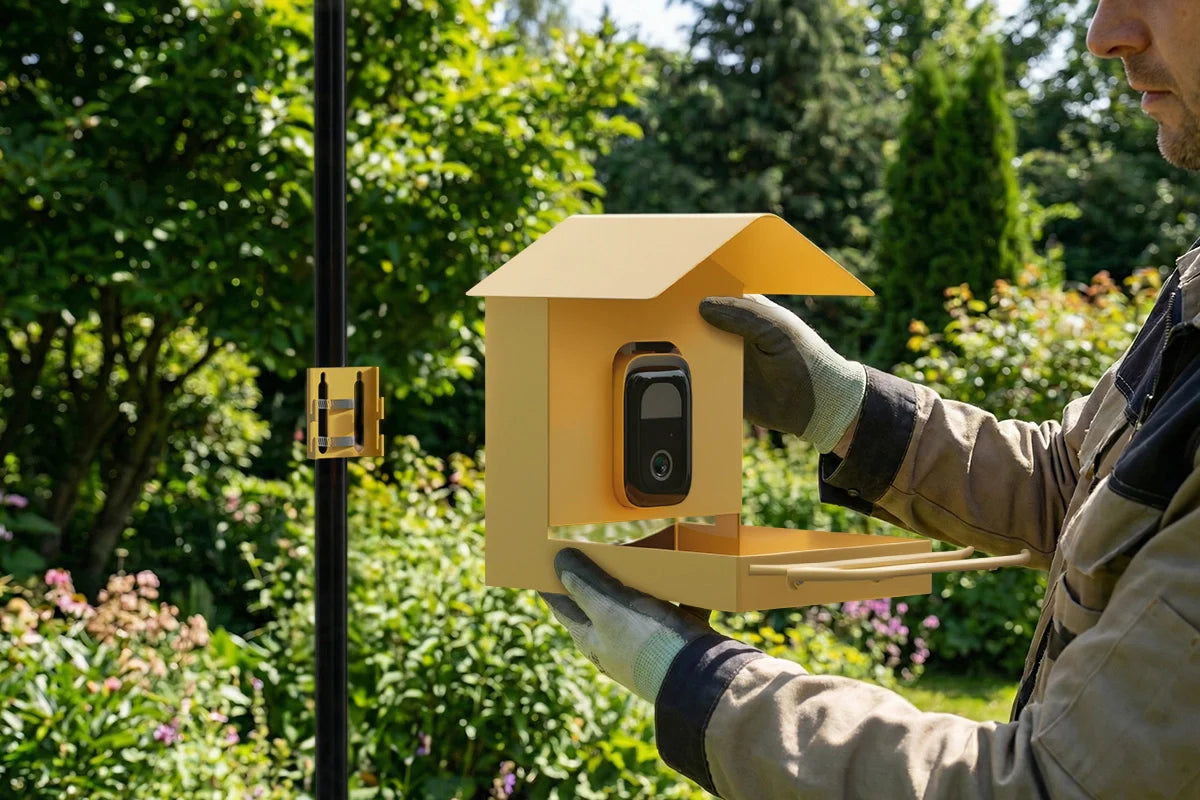
Pole mounting provides the best control over height, security, and placement relative to Wi-Fi. It is the most recommended method for reliable performance of your smart bird feeder with camera.
Pros: Easy to apply anti-squirrel baffles, excellent camera height control, and minimal obstruction for Wi-Fi signals.
Cons: Requires purchasing a separate pole and ground anchor.
Best For: Users serious about maximizing AI identification quality and deterring squirrels.
Method 2: Deck Railing or Fence Mounting
This method uses simple clamps or short bracket screws to attach the smart bird feeder camera housing to a flat surface.
Pros: Quickest and easiest installation, close proximity to the house for better Wi-Fi.
Cons: Can provide easy access for squirrels via the railing, and the height may be too low for optimal camera angle.
Best For: Urban or suburban settings where the deck is the only viable location.
Featured Review: Mounting the bilantan Smart Bird Feeder
The bilantan smart bird feeder (often sold as the 5G wifi bird feeder with camera) is designed with flexible mounting in mind, featuring a robust, adjustable bracket.
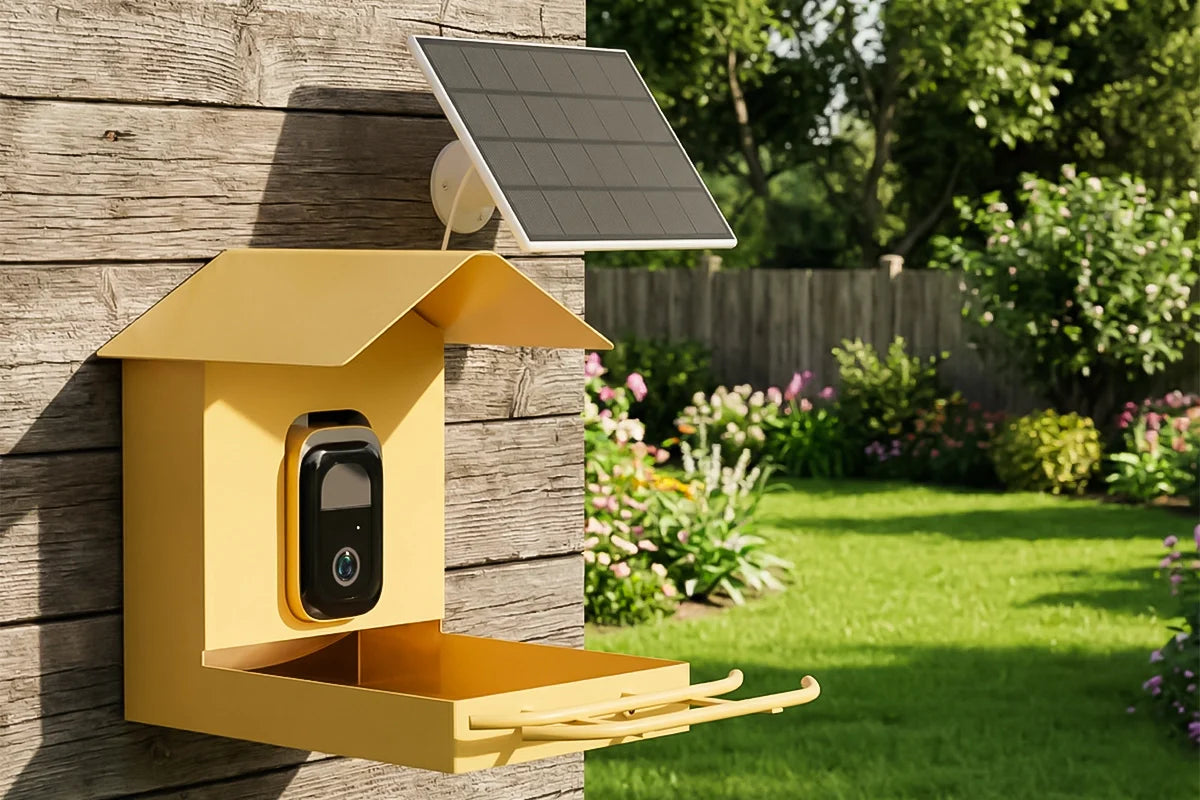
Mounting System: It includes both a strap/clamp mount for attaching to poles or railings and a screw-in wall mount bracket. The mounting arm is fully articulated, allowing users to fine-tune the camera angle precisely to focus on the perch, which is crucial for its high-accuracy AI.
Solar Panel Integration: The included solar panel uses a separate mounting arm connected via a long cable, allowing you to mount the feeder in a partially shaded, ideal bird-viewing spot, while mounting the panel separately in a sunny, unobstructed location. This separation is a key advantage over competing integrated models.
Durability: The bilantan’s mounting bracket is made of reinforced polymer, providing necessary stability for the unit's camera housing and its large seed capacity.
Comparison of Top 5 Smart Bird Feeder Mounting Methods
|
Model |
Primary Mounting Method |
Recommended Placement |
Squirrel Baffle Compatibility |
Ideal Wi-Fi Range |
|
bilantan smart bird feeder |
Adjustable Clamp/Screw-in Bracket |
Dedicated Pole or Deck Railing |
Excellent |
Optimal (Due to 5G wifi bird feeder with camera) |
|
Bird Buddy |
Hanging Hook/Pole Adapter |
Hanging or Pole Mount |
Good (Requires Adapter) |
Standard |
|
Netvue Birdfy |
Bracket/Straps |
Wall, Tree, or Pole |
Good |
Standard |
|
Soliom Feeder |
Fixed Bracket |
Wall or Fence Post |
Fair (Requires high-mounted baffle) |
Good |
|
BirdKiss Feeder |
Hook/Rope (Hanging) |
Shepherds Hook |
Fair |
Standard |
Smart Bird Feeder Buyer’s Guide and Maintenance
This section incorporates long-tail keyword variations centered around mounting and placement.
Buying Guide: Best Smart Bird Feeder for Specific Mounting Needs
Your buying decision should be influenced by your backyard layout, especially concerning the question of how to mount smart bird feeder effectively.
Best Smart Bird Feeder for Deck Mounting: Choose models with sturdy, adjustable clamps and easy-access battery compartments (for charging), as deck railings make manual swaps easy.
Best Smart Bird Feeder for Remote Pole Placement: Prioritize models with excellent Wi-Fi range (like dual-band or 5G capability) and built-in solar charging (e.g., the bilantan) to minimize the need for manual interaction far from the house.
Best Smart Bird Feeder for Tree Mounting: Look for models with flexible strap systems. However, be aware that tree mounting is the most prone to squirrel access.
[Internal Link Placeholder 1: Insert Link to a Specific Bilantan Mounting Accessory]
Maintenance Tips Related to Mounting
Proper mounting isn't a one-time task; it requires periodic checks for sustained performance and security.
Level Check: After heavy wind or ice, check that your smart bird feeder is still level. A tilted feeder can confuse the AI and affect camera focus.
Obstruction Clearing: Prune back tree branches or vines that grow near the feeder. They can obscure the camera's view, interfere with the motion sensor, and provide jump-off points for pests.
Solar Panel Cleaning: If your bilantan smart bird feeder uses a solar panel, ensure it is mounted facing south (in the Northern Hemisphere) and is wiped clean of dust, pollen, or bird droppings at least once a month.
[Internal Link Placeholder 2: Insert Link to a General Smart Home/Outdoor Security Product Page]
Conclusion: Perfect Placement for Perfect Pictures
Mastering how to mount smart bird feeder devices is the crucial link between owning a high-tech gadget and enjoying a successful, fulfilling bird-watching experience. The optimal mounting position simultaneously solves problems of image quality, connectivity, and predator deterrence. Neglecting placement leads to frustration; mastering it leads to a steady stream of high-quality photographs and accurate AI identifications.
Key takeaways for your North American backyard include prioritizing pole mounting with a baffle for pest control and always testing your Wi-Fi signal before permanent installation. For users prioritizing high-resolution video and low maintenance, the bilantan smart bird feeder with its adjustable, separate solar mounting system offers maximum flexibility and performance.

bilantan smart bird feeder
Stop dealing with blurry images and weak signals. By implementing these expert mounting strategies, you ensure your smart bird feeder with camera is positioned for peak performance. Click here to secure the right mounting accessories for the bilantan feeder and start capturing professional-quality images of your backyard wildlife today!

Leave a comment
All comments are moderated before being published.
This site is protected by hCaptcha and the hCaptcha Privacy Policy and Terms of Service apply.